In Magic, a party consists of four creatures, one of which has the type Cleric, another of which has the type Rogue, and the same for Warrior and Wizard. While tuning a deck of mine based on the party mechanic, I wondered what the optimal distribution of creature types might be. To that end, I put together this calculator that computes for you probabilities based on the distribution of creature types in your deck.
Calculator
In the following fields, input the number of creatures having each exact creature type in your deck (e.g. a creature that is both a cleric and a rogue should be counted in the field in the top center and not in any other field). Note that there is no field for creatures that are exactly three of the creature types because I’m not aware of any.
Scryfall Search Prefix:
Deck Size:
There are parties among sets of four creatures in your deck.
You have a chance to draw a party in your opening hand.
Chance of a party among sets of creatures:
| Number of creatures: | 3 | 4 | 5 | 6 | 7 |
How the Computations Work
In this section, I’ll explain how the above calculator works. The fact that each creature in your party can only count toward one of the four creature types makes these computations a little complicated. My method is likely pretty inefficient, so if you have any ideas for a more clever way to perform these computations, I’d love to hear about it!
Let $N$ be the total number of creatures in the deck. Our strategy will be to compute the number of subsets of size $n$ form a valid party. To compute the probability, we divide this number by the total number ${N\choose n}$ of size $n$ subsets.
A multiset is a set with repetitions allowed. If a multiset has $m_i$ copies of $a_i$ for all $1\leq i\leq k$, we will denote this multiset as
\[\{\!\{a_1^{m_1},a_2^{m_2},\ldots,a_k^{m_k}\}\!\}.\]Let $\mathcal{T}$ be the set of creature types Cleric, Rogue, Warrior, and Wizard. For a subset $S\subseteq\mathcal{T}$, let $N(S)$ denote the number of creatures with the creatures types in $S$ but none of those in $\mathcal{T}\setminus S$.
To determine if a set of creatures form a party, we need only know the multiset of their creature types among $\mathcal{T}$. For example, the set of creatures
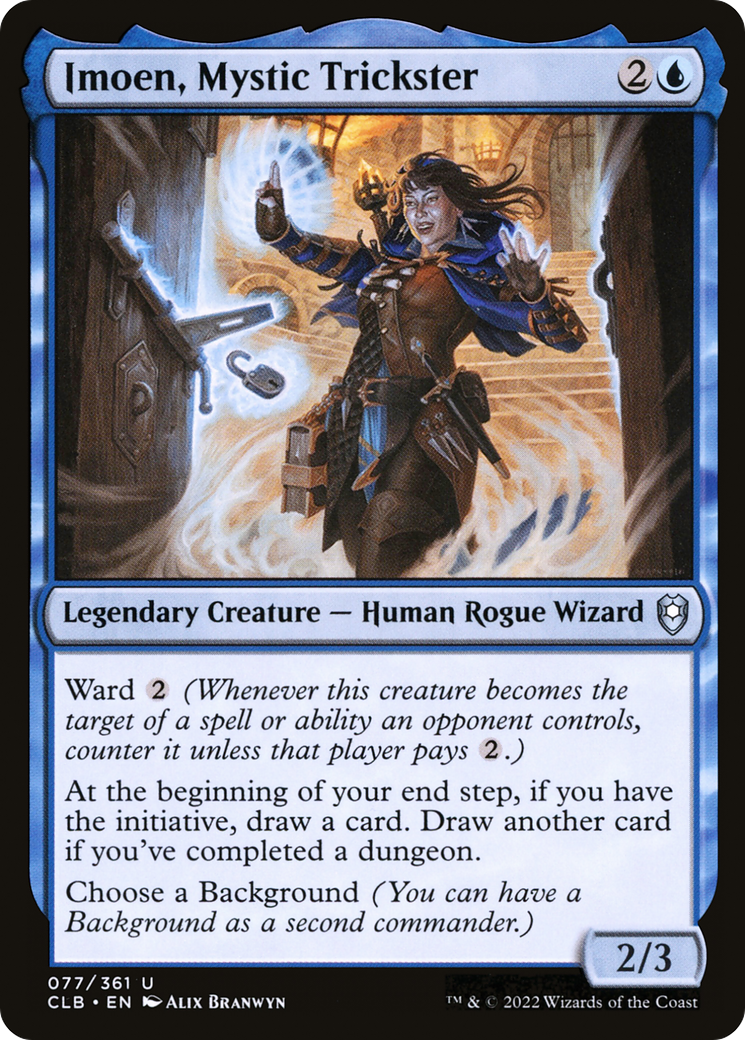
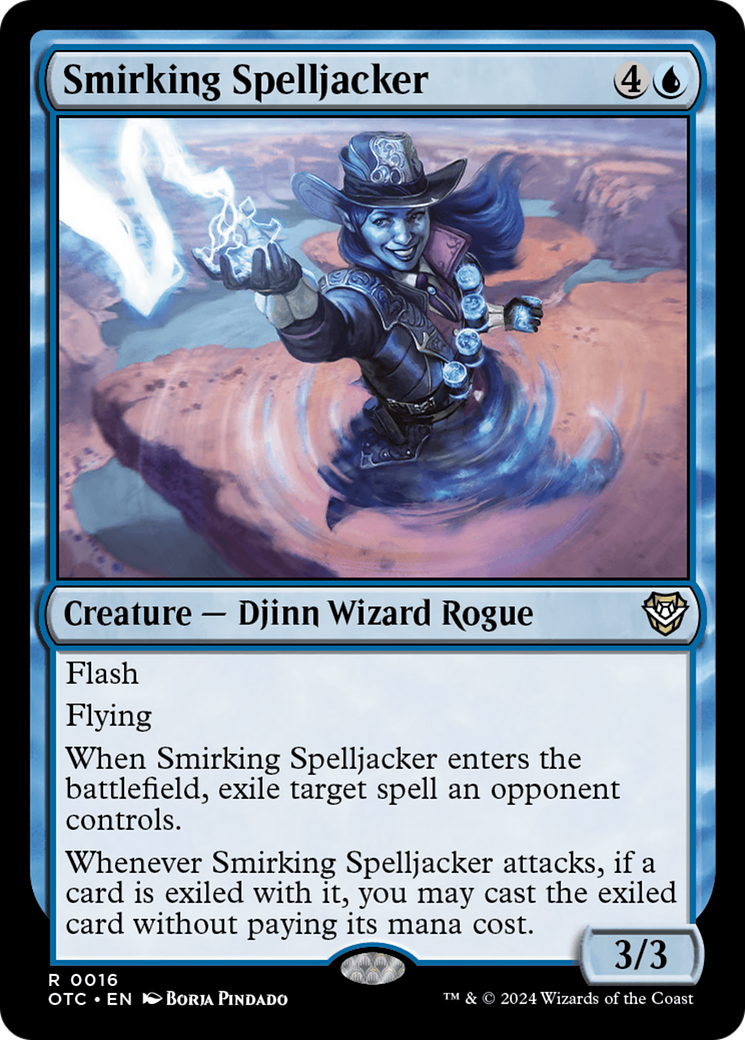
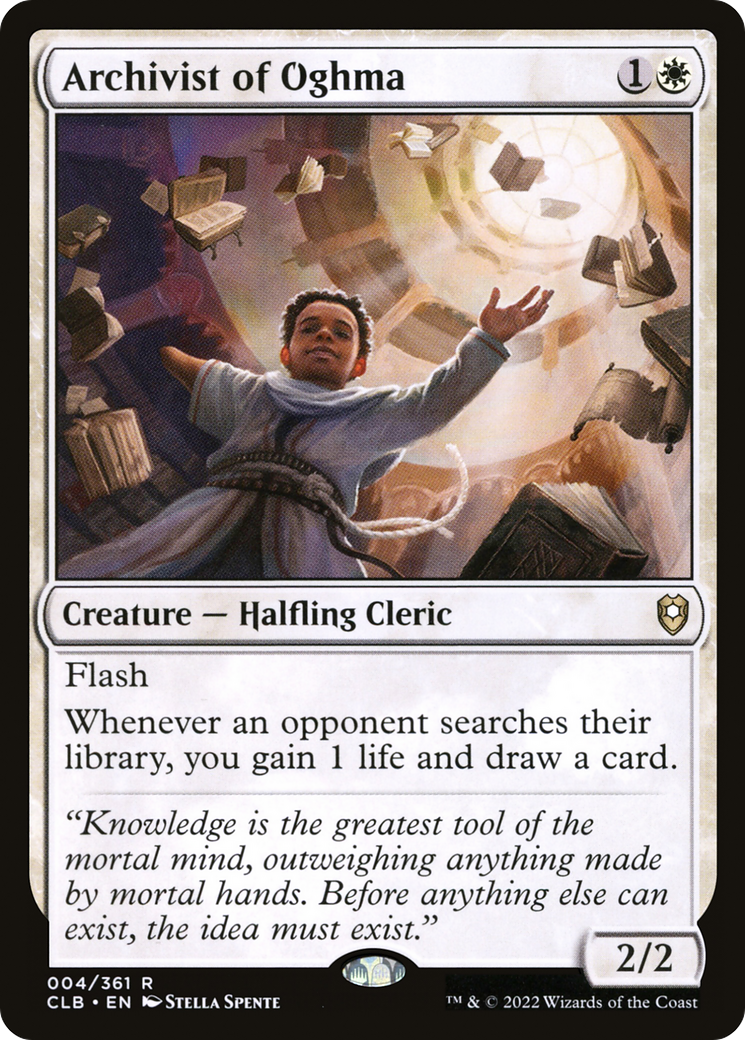
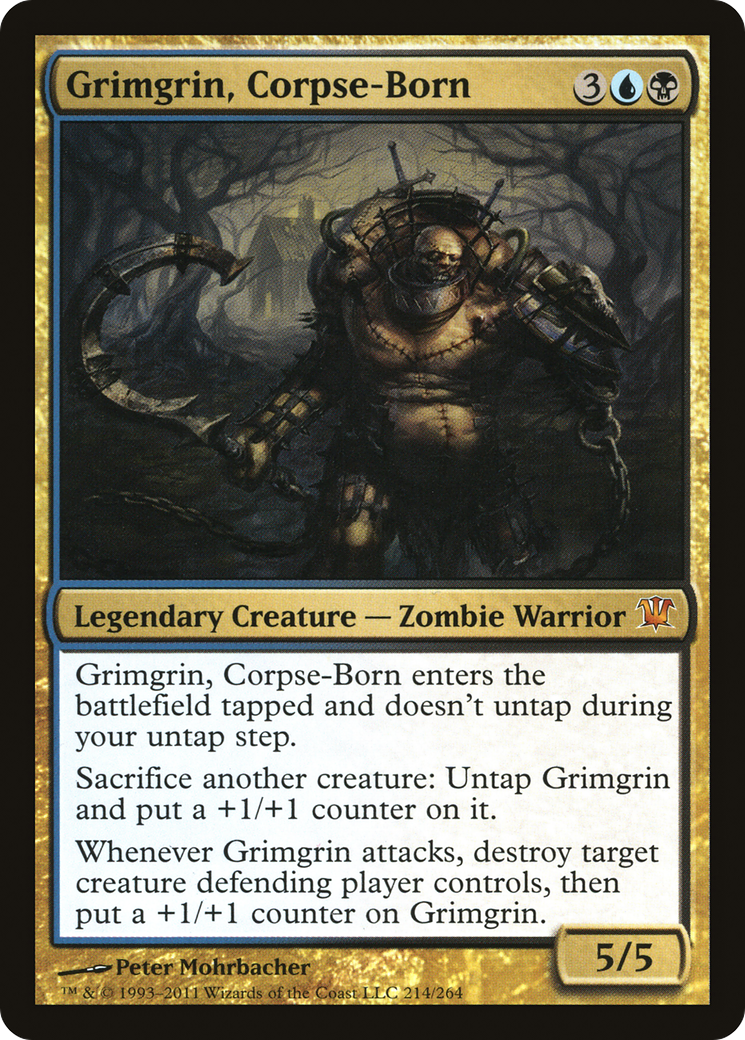
has the corresponding multiset
\[\{\!\{\{Rogue, Wizard\},\{Rogue, Wizard\},\{Cleric\},\{Warrior\}\}\!\}.\]The number of parties corresponding to this multiset is computed as follows. There are ${N({Rogue, Wizard})\choose2}$ ways to select the first two creatures. There are $N({Cleric})$ and $N({Warrior})$ ways to choose the reamining two creatures respectively. In total, there are
\[{N(\{Rogue, Wizard\})\choose2}\cdot N(\{Cleric\})\cdot N(\{Warrior\})\]parties with this configuration of creature types. In general, the number of parties with corresponding configuration
\[\{\!\{S_1^{m_1},S_2^{m_2},\ldots,S_k^{m_k}\}\!\}\]has
\[{N(S_1)\choose m_1}\cdot{N(S_2)\choose m_2}\cdots{N(S_k)\choose m_k}\]corresponding parties.
Let $\mathcal{P}_n$ denote the set of all size-$n$ multisets like the above that contain a party. Then the number of parties of size $n$ will be the sum of the above formula over all multisets in $\mathcal{P}_n$. I pre-generated the sets $\mathcal{P}_4$, $\mathcal{P}_5$, $\mathcal{P}_6$, and $\mathcal{P}_7$ by iterating over selecting four sets of creature types containing Cleric, Rogue, Warrior, and Wizard respectively, then padding out with additional creature type sets to reach the desired number $n$. Unfortunately, this produces many duplicates, so I had to run through and remove repeats.
Fun Facts and Edge Cases
As of May 1st, 2026, there are 601,764,894,387 distinct parties among creatures in paper Magic. There is only about a 0.1018% chance that a randomly selected set of four creatures in paper Magic forms a party. These numbers were computed using Scryfall searches as in the links above, so it’s possible there are some edge-cases. For example, Irregular Cohort comes with two changelings, so any set consisting of it and two distinct party types forms a party. Similarly, Mage’s Attendant provides both a rogue and a wizard.
These sorts of creatures can represent two creatures in your party, so the above calculator is a bit of an underestimate if these edge cases are involved.