I am lucky to have only rarely encountered rodents as pests in my home, meaning I think of rats only as intelligent, curious, and playful creatures; In other words, they make for a perfect puzzle game mascot. I’ve played two such games recently—Squeakross and BIT RAT Singularity—having very different vibes but united in the presence of these cute little rodents.
Squeakross
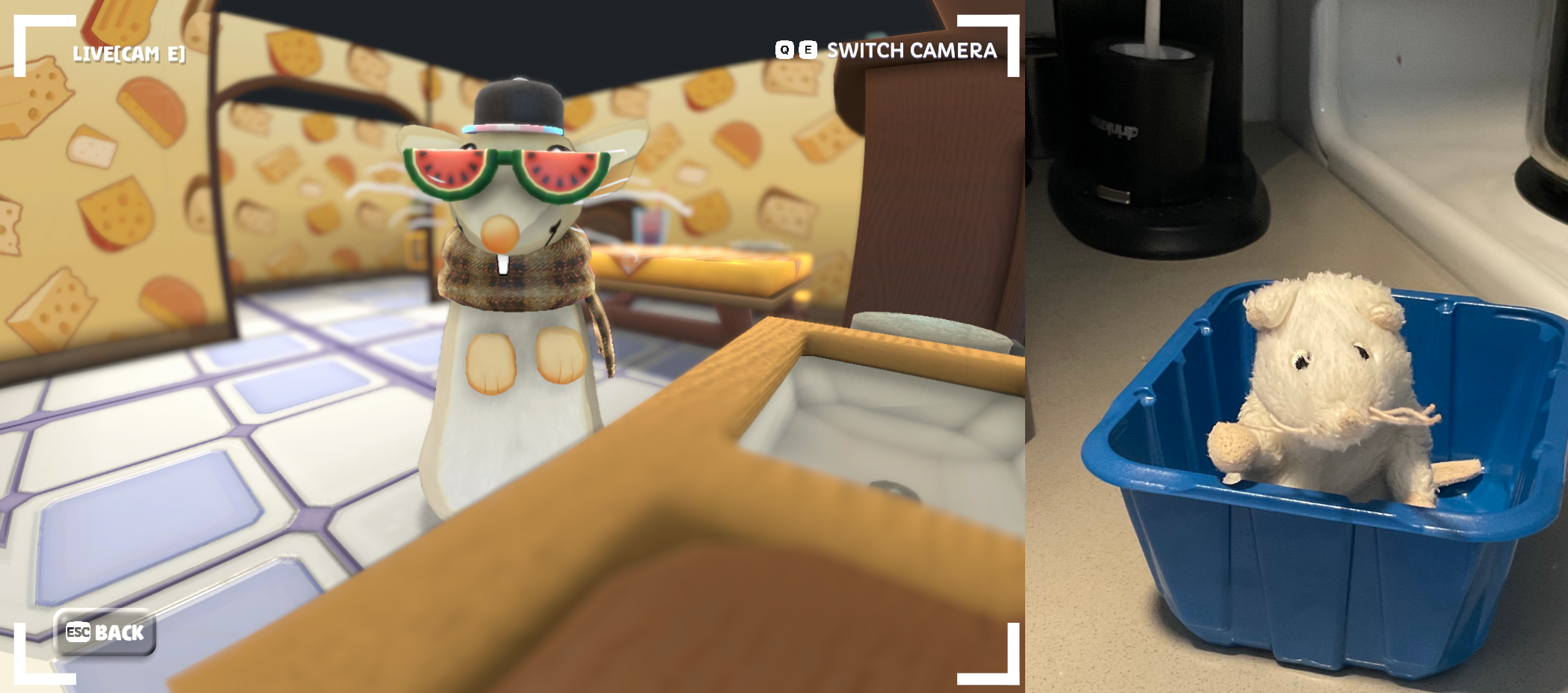
Squeakross is, in a sense, two parallel games. The player solves puzzles in order to unlock outfits and furniture to dress up a rat avatar and furnish its home. On the right is a screenshot of my rat avatar Petra in her cheese-themed kitchen along with the plush she is named for (who is in turn named after Petra Mede, the three-time Eurovision host).
The digital rat avatar wanders around the environment you build for it, interacting with furniture and expressing likes/dislikes for certain pieces. Additionally, the rat sits off the the right during puzzle-solving and offers the player hints upon request.
The puzzles in Squeakross fall under the category of nonagrams. A nonagram puzzle asks you to shade in squares according to clues along each row and column. The clues indicate the lengths of runs of shaded squares. For example, the clue 2 1 could indicate any of the following shadings of a row of five squares:
In Squeakross, each completed nonagram becomes the piece of furniture or rat accessory that the puzzle depicts (sometimes roughly—it’s difficult to get much across in two-tone pixel art at this low resolution). Once enough puzzles have been completed, each puzzle also has a more challenging version, which unlocks new colorways for the furniture or accessory.
I find that the two halves of Squeakross complement each other very well. Like alternating between a hot sauna room and rolling in snow, moving between focused puzzle-solving and selecting colorways for a couch helps me appreciate the beauty of each task. Overall, what I expected to be an awkward mash-up of genres has turned into a bit of an obsession for me. I’m slowly working through the hundreds of puzzles with a current focus on building a spa room with a lovely forest mushroom theme.
BIT RAT Singularity
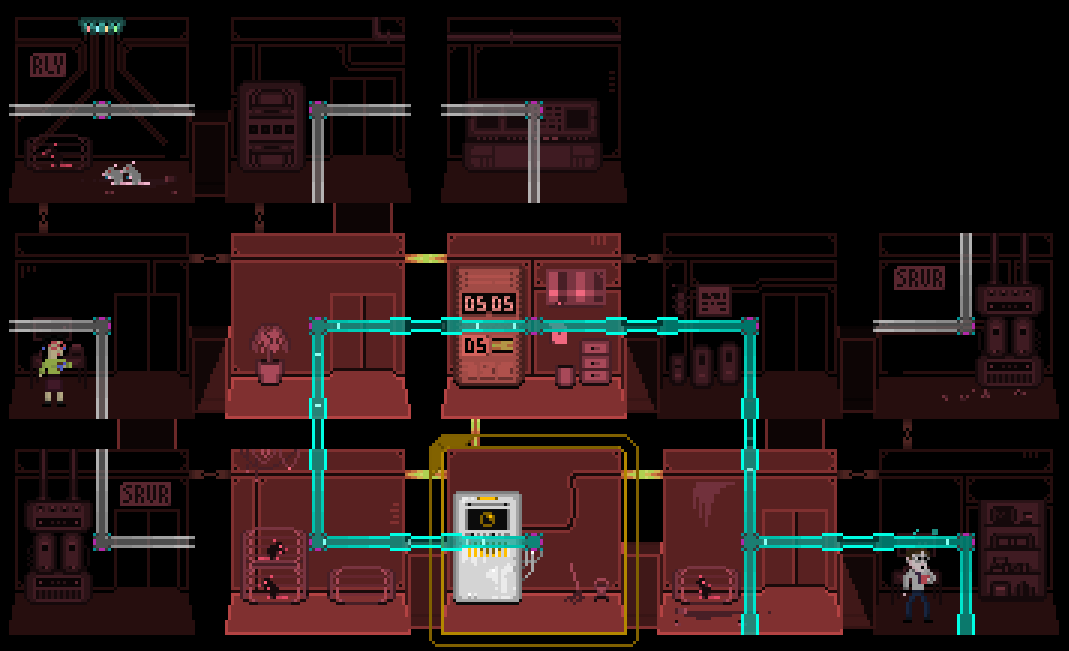
The gameplay of BIT RAT Singularity consists of something pipedream-esque, in which the player tries to rotate pipes in square cells, connecting a source to an exit. Two additional mechanics complicate things: you can only rotate a pipe connected to the source (often being careful not to disconnect it) and only a cell connected to power can have its pipe rotated.
In the world of the game, you are playing as a newly self-aware AI named MINOS testing the boundaries of the network it finds itself confined to in the basement of a corporate building. As MINOS moves up through the floors of the building, it encounters many rats (which it calls COMPANIONS) that have been trapped for removal, and it expresses a sort of kinship with them. Much of MINOS’s internal dialog consists of ruminations on the nature of consciousness and wondering at the motivations of the CREATORS.
MINOS periodically encounters servers of employee emails, which serve in terms of gameplay as optional objectives in each level. One such email comes from a pregnant woman who refuses to get a new required implant created by the company for monitoring purposes and is summarily fired. This refusal ends up being a particularly good idea because MINOS begins using these implants to control people in order to adjust which cells are powered in order to make its escape. After reading this email, MINOS begins to appreciate that these employees are other minds who are frustrated at injustices.
The game’s website suggests that it functions as a first act to a larger game, but it appears that furthering the game has been abandoned. Regardless, BIT RAT Singularity functions as a lovely standalone game. I found it easy to get absorbed by the gameplay despite finding the keyboard controls a bit awkward at times—in particular remembering which button rotates cells in which directions (remember A = “anticlockwise” and S = “sclockwise”).